Wow, a year since I touched this. Okay, well. Gonna see if I can be a bit more regular in 2022. No promises.
Rock Rock Rock (rock rock) – part 2
Right, so, in Part 1 I talked about my first step in game design, which is an idea. Seems rather silly to point out that being a first step, so anyway.
Lets talk about step 2, which is rough mechanics.
I touched on a bit about the rough mechanics for Rock Rock Rock (rock rock)… Wow, I’m going to shorten that to RRRrr. Much easier. Basing it on a 5 item rock-paper-scissors mechanic.
So, let’s start by defining our 5 different items.
What kind of rocks are there? More importantly, what would cavemen see them as?
Well… Just spitballing here but how about:
- Hard Rock
- Pointy Rock
- Heavy Rock
- Chalky Rock
- Shiny Rock
We need to set up a table to make sure we have everything in balance, lets start with a mostly blank matrix. where we’ve filled in a tie:
| vs | Hard | Pointy | Heavy | Chalky | Shiny |
| Hard | Tie | ||||
| Pointy | Tie | ||||
| Heavy | Tie | ||||
| Chalky | Tie | ||||
| Shiny | Tie |
Now, filling out the rest by just common sense:
| vs | Hard | Pointy | Heavy | Chalky | Shiny |
| Hard | Tie | Hard | Heavy | Hard | Shiny |
| Pointy | Hard | Tie | Heavy | Pointy | ??? |
| Heavy | Heavy | Heavy | Tie | Heavy | ??? |
| Chalky | Hard | Pointy | Heavy | Tie | Chalky |
| Shiny | Shiny | ??? | ??? | Chalky | Tie |
Well, this is a problem. So, the what the matrix above says, is that the common-sense of what beats what is skewed. In some cases, like Heavy, it’s overpowering, and in other cases, like Shiny, we have no idea. So, back to the drawing board.
| vs | Hard | Pointy | Heavy | Chalky | Shiny |
| Hard | Tie | Hard | Heavy | Hard | Shiny |
| Pointy | Hard | Tie | Heavy | Pointy | Pointy |
| Heavy | Heavy | Heavy | Tie | Chalky | Shiny |
| Chalky | Hard | Pointy | Chalky | Tie | Chalky |
| Shiny | Shiny | Pointy | Shiny | Chalky | Tie |
So, in this case, the common sense factor had to take a bit of a back seat. You can make some logical wiggle to get around some things, but in any case, we have a matrix, where each item has 2 win conditions, 2 lose conditions, and a tie condition…
The tie could be a problem if you want a definitive winner. We’ll come back to that later.
< Back to Part 1
Rock Rock Rock (rock rock) – Part 1
Okay, so, because this got stuck in my head, I’m putting it down for future generations to get a glimpse of how my game design process goes.
Step one: Come up with an idea. It doesn’t have to be perfect, but it has to exist. Its kind of like writing. Your first draft is not going to be the final draft, but if you don’t start, you won’t get there. So, step one: idea.
In this case, we’re going to use the idea for a game I’m calling Rock Rock Rock (rock rock).
Note the originality of the title. Yes, shut up. I meant to do that. It’s deliberate, and I think I’m clever.
Anyway, the idea came from a rather strange conversation at my FLCS/FLGS. Where speaking to the owner, the statement of: “How did cavemen break ties, they couldn’t exactly play rock-paper-scissors.” was floated into the aether.
Thus was born a seed for a new game.
Okay, everyone knows Rock-Paper-Scissors, it’s a children’s game we still play as adults, because we are all children deep down. Also, just about literally everyone has played it. The rules don’t need to be explained to most people.
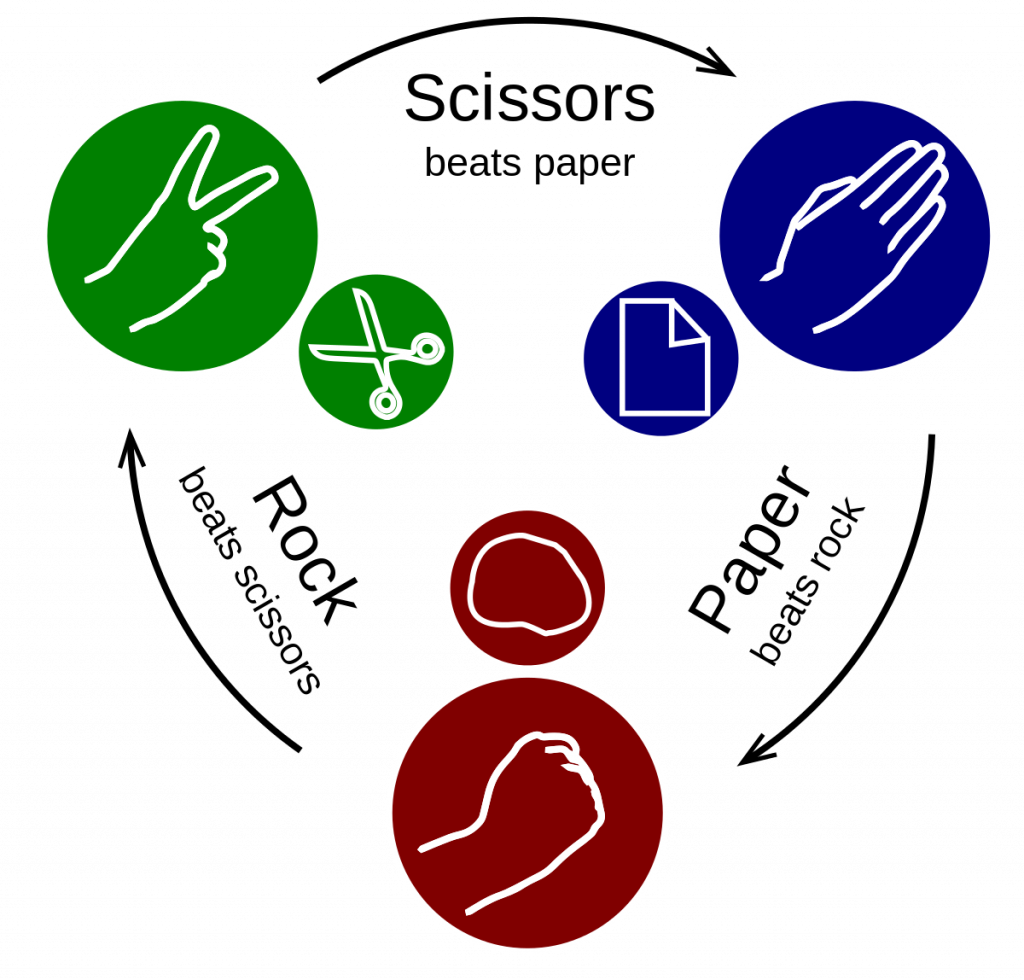
There’s a simple progression, where each option can be countered by exactly one option and counters the other option. Rock beats Scissors beats Paper beats Rock…
There’s actually a mathematical model for this sort of game, where you can increase the number of options to any odd number and then each move will have (N-1)/2 wins/losses for any given option.
So in the case of R-P-S, there are 3 options.
And the formula becomes (3-1)/2 = 1; So one possible win or loss per option.
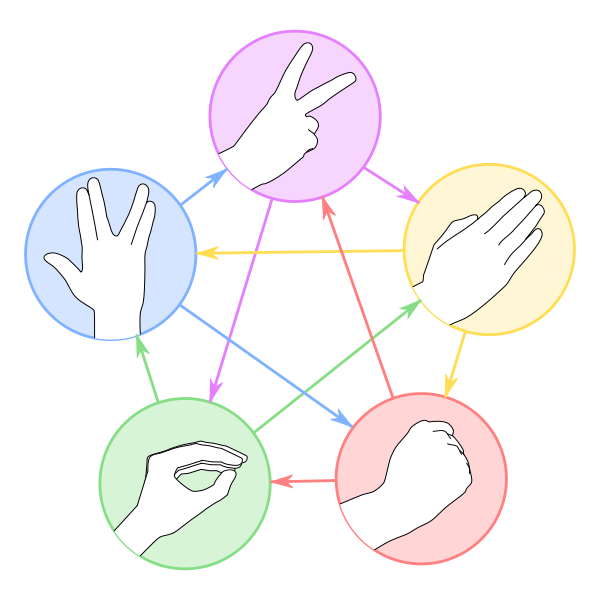
So, what happens when we go to 5?
Well, to borrow from the BBT, where you have Rock Paper Scissors Lizard Spock… You can see that each option has 2 wins and 2 losses. once again, (N-1)/2.
So what does this have to do with game design, it’s obvious that this isn’t new?
Well, a lot of times, game design is adding variation and theme to a game that already exists. And we’ll get into that in the next part.
On to Part 2 >
The dice tower oubliette: Embarrassing myself and confusing people 101…
So, I’ve sent a couple of dice tower pieces to some folks, notably folks who are also the kind of people who collect shiny math rocks.
Anyway. Apparently I’ve confused people because one of the pieces I’ve sent is the oubliette (which will be a late release on Pateron) which comes in 6 pieces. I swear it was in one piece when it went into the box, and it’s supposed to be hard to fall apart, but it fell apart.
So anyway, for future reference. How to put together the oubliette:
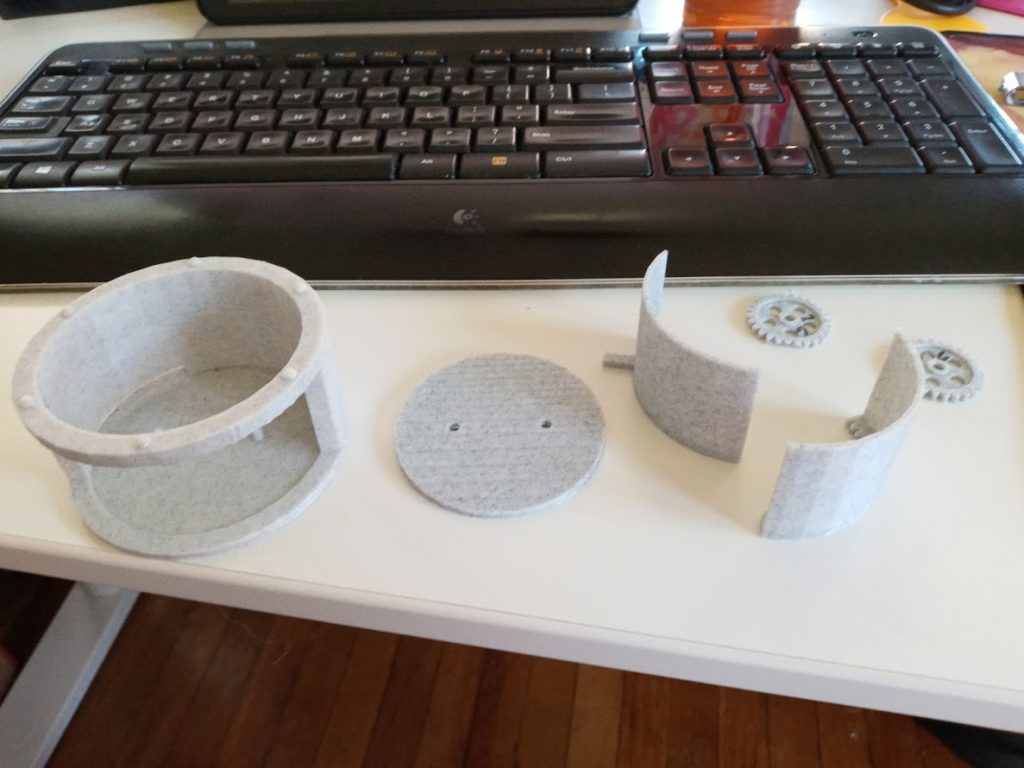
So, all the parts of the oubliette: the Frame, the Base, Left and Right hand doors, and the gears.
Step one: Put the left and right hand doors into the frame. The left hand door (as you look at it) has a tab that fits into the cutout on the left hand side. Make sure you center the doors so they meet in the middle.
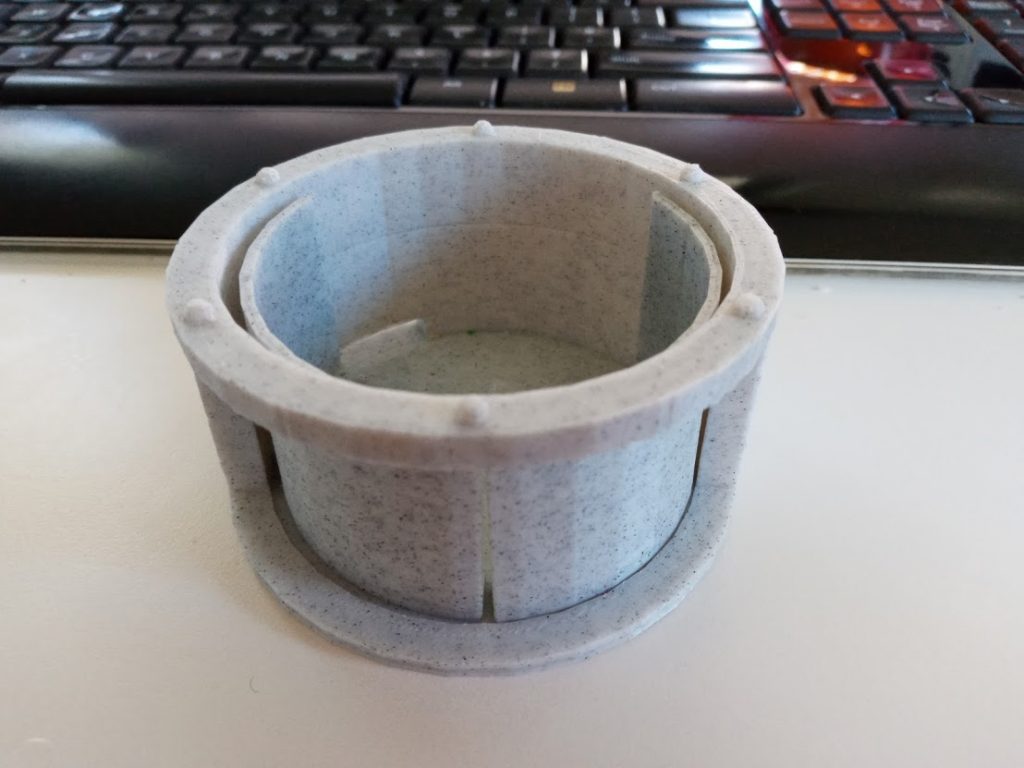
Step two: Drop the gears on the posts so they mesh up with the gears on the doors. The gears are identical, so it doesn’t matter which one goes on which side.
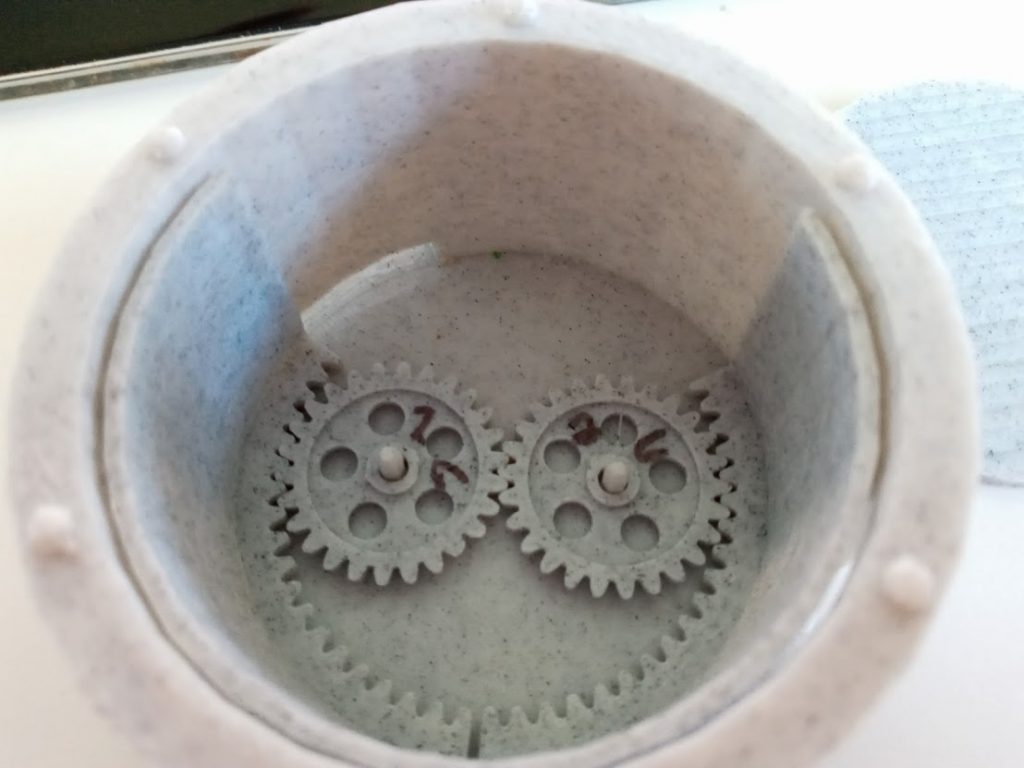
Step three: Drop the base on top of the posts with the slope pointing towards the doors, and push down. It should fit snugly.
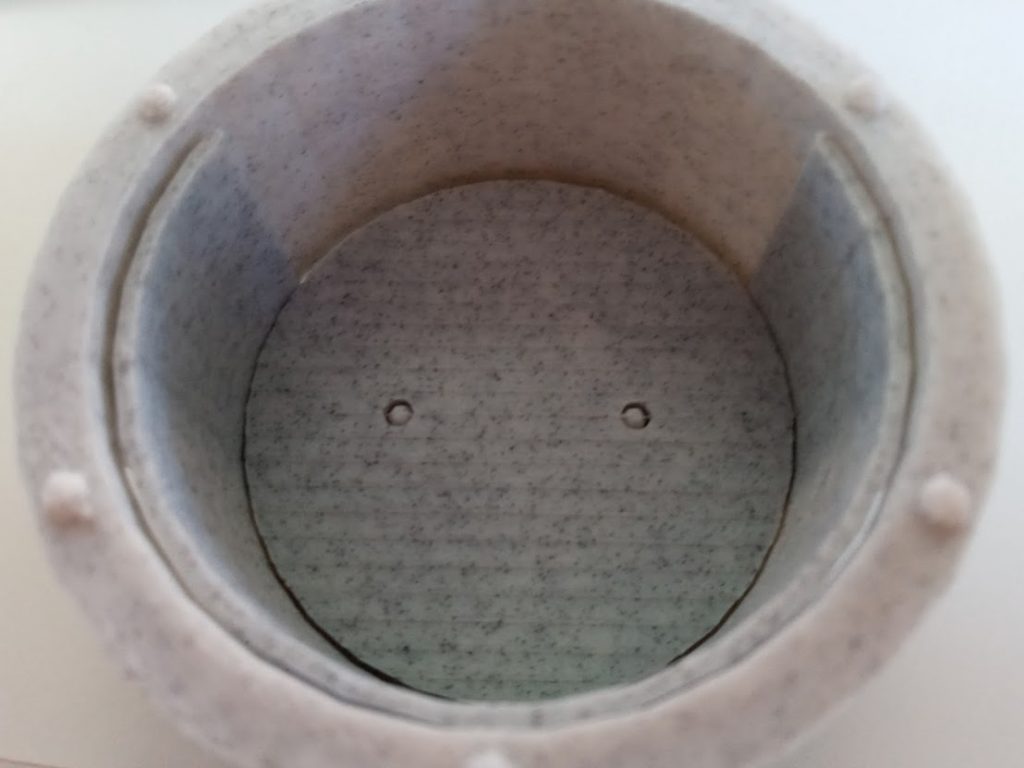
Complete! The oubliette will now open and close the doors by pushing on the little tab on the left hand side (your left, looking at the doors)
Apologies for any bafflement I might have caused!
The Dice Tower… Or how to waste several hundred hours of 3D Print time…
One of my late 2020 projects was a modular dice tower that could be printed up on my 3D printer. The first couple of levels were fun…
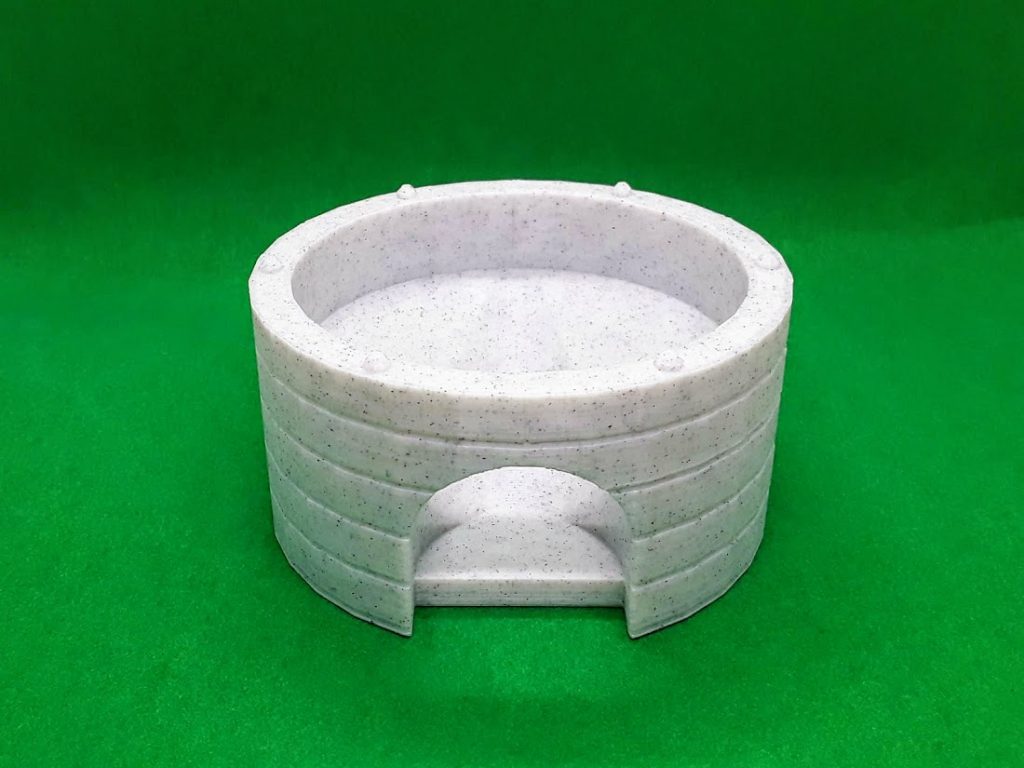
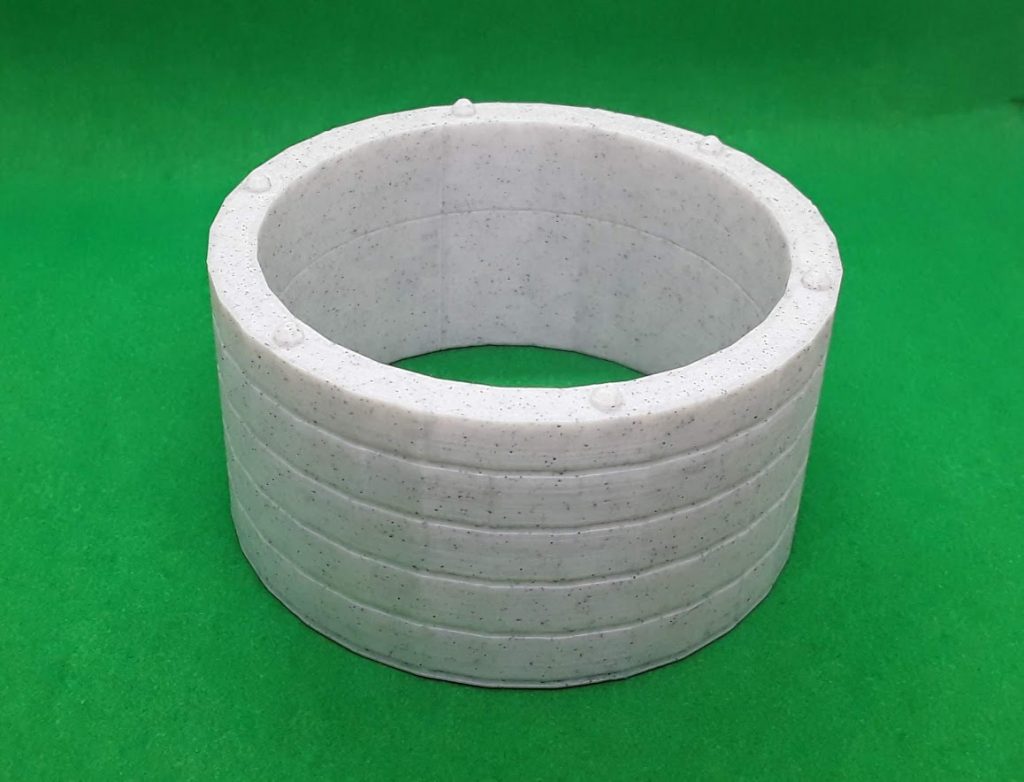
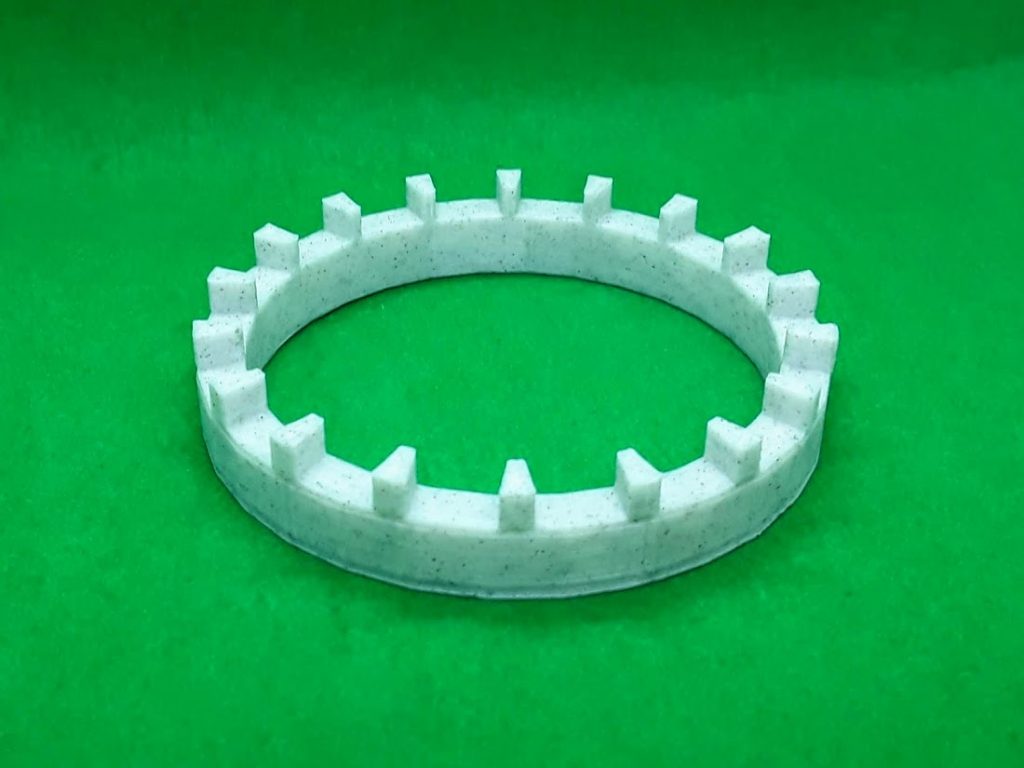
And then I decided to go full tilt idiot, and I kept going.
I’m now up to 27 or 28 (depending on how you look at things) unique sections ranging from custom tops, to exits, randomizers, windows, etc etc etc. It really got incredibly silly, really really quickly.
So, like any modern day idiot, I put them up on my Patreon.
So, this is the dice tower experiment, which I’ll be slowly releasing new STLs and CAD files over the entirety of 2021.
Like I said, the tower is slowly being released over at my Patreon, along with other weirdness that is lodged in my brain.
Deck Builder – Open Beta?
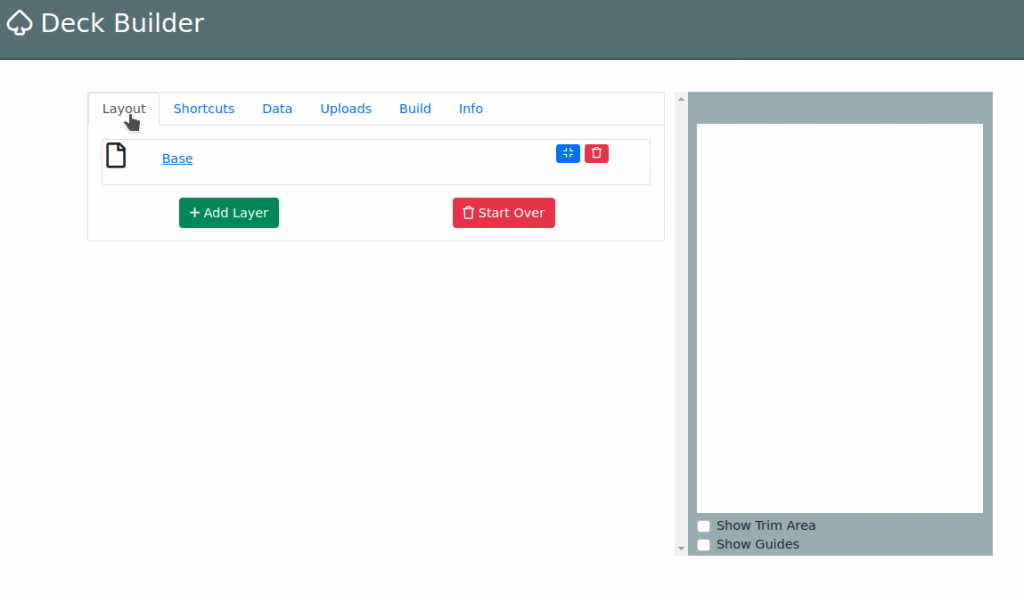
So, I’ve been spending a few nights working on this new game design tool for, well, game designers.
Deck Builder is meant to take all the crappy repetitive work of building cards. Your decks are usually fairly regular, you have icons in specific places, text here, images there. Those items may change, but their positions won’t.
This lets you create a card layout in real time, then gives you a spreadsheet that you can then use to create your deck. So, do the fussy layout work live on the web, and once it’s exactly what you want, use the spreadsheet to put all your card data into the machine. And viola, a deck of print ready cards pops out the other end.
Nice, huh?
Go check it out at: https://deckbuilder.rcsipublishing.com/
Thanks!
Getting Ready for Winter NonePub 2021
Okay, so. First post.
Last month I signed up to participate in Winter NonePub 2021. I took one of my games to the UnPub event at PAX Unplugged in 2018, and felt it was well received.
This year, I’m bringing out that game as well as 4 other games I’ve developed since then.
- Graveyard Shift
- Scripted
- CRAM
- Deal
- Gooze
but more on those later…