Right, so, in Part 1 I talked about my first step in game design, which is an idea. Seems rather silly to point out that being a first step, so anyway.
Lets talk about step 2, which is rough mechanics.
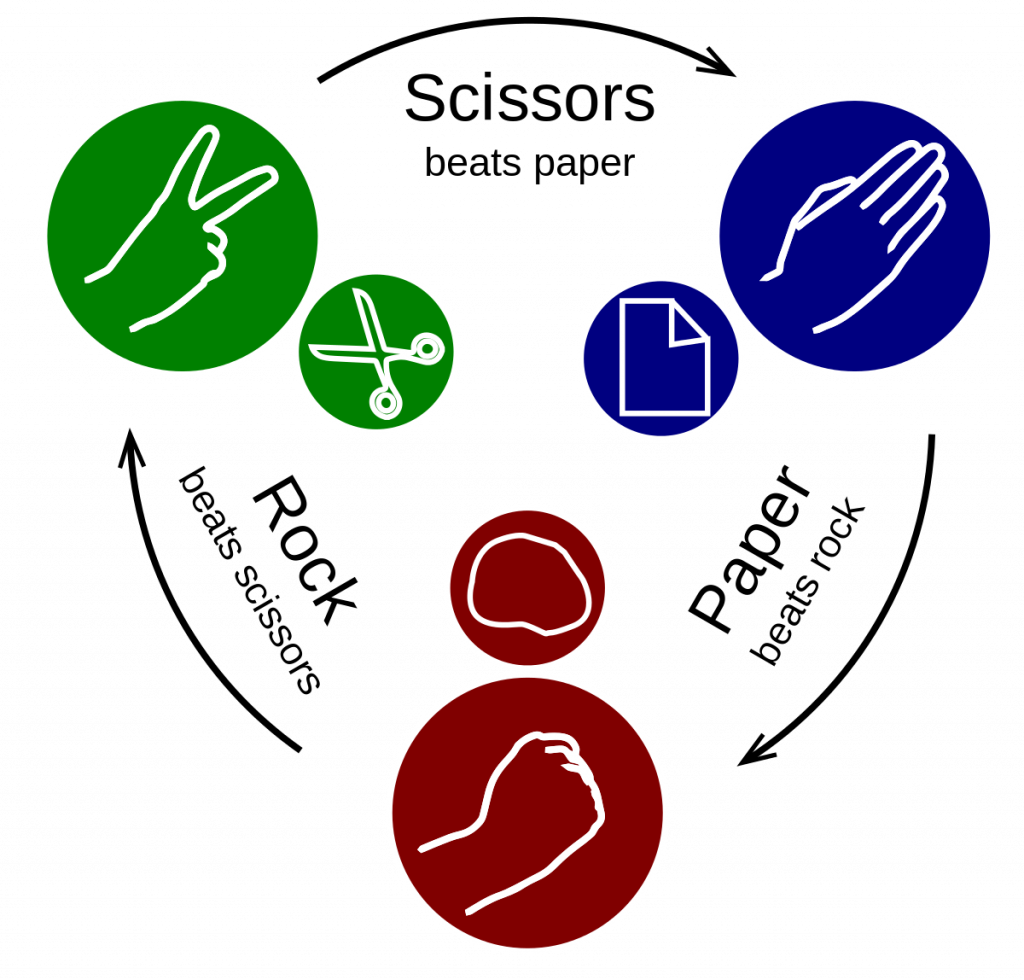
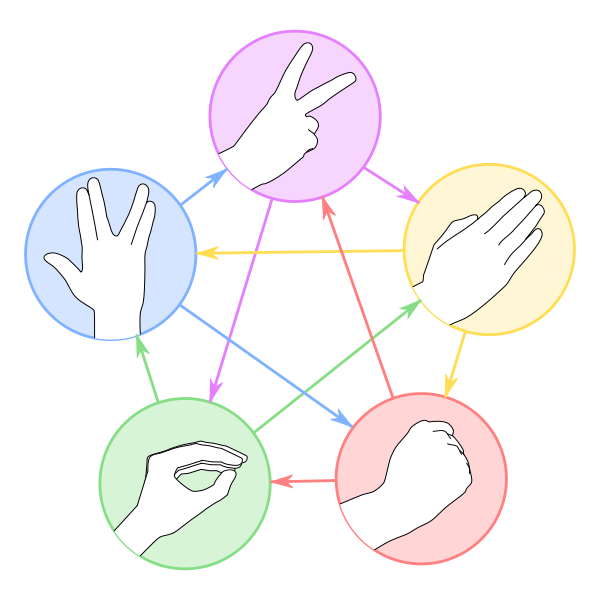
I touched on a bit about the rough mechanics for Rock Rock Rock (rock rock)… Wow, I’m going to shorten that to RRRrr. Much easier. Basing it on a 5 item rock-paper-scissors mechanic.
So, let’s start by defining our 5 different items.
What kind of rocks are there? More importantly, what would cavemen see them as?
Well… Just spitballing here but how about:
- Hard Rock
- Pointy Rock
- Heavy Rock
- Chalky Rock
- Shiny Rock
We need to set up a table to make sure we have everything in balance, lets start with a mostly blank matrix. where we’ve filled in a tie:
| vs | Hard | Pointy | Heavy | Chalky | Shiny |
| Hard | Tie | ||||
| Pointy | Tie | ||||
| Heavy | Tie | ||||
| Chalky | Tie | ||||
| Shiny | Tie |
Now, filling out the rest by just common sense:
| vs | Hard | Pointy | Heavy | Chalky | Shiny |
| Hard | Tie | Hard | Heavy | Hard | Shiny |
| Pointy | Hard | Tie | Heavy | Pointy | ??? |
| Heavy | Heavy | Heavy | Tie | Heavy | ??? |
| Chalky | Hard | Pointy | Heavy | Tie | Chalky |
| Shiny | Shiny | ??? | ??? | Chalky | Tie |
Well, this is a problem. So, the what the matrix above says, is that the common-sense of what beats what is skewed. In some cases, like Heavy, it’s overpowering, and in other cases, like Shiny, we have no idea. So, back to the drawing board.
| vs | Hard | Pointy | Heavy | Chalky | Shiny |
| Hard | Tie | Hard | Heavy | Hard | Shiny |
| Pointy | Hard | Tie | Heavy | Pointy | Pointy |
| Heavy | Heavy | Heavy | Tie | Chalky | Shiny |
| Chalky | Hard | Pointy | Chalky | Tie | Chalky |
| Shiny | Shiny | Pointy | Shiny | Chalky | Tie |
So, in this case, the common sense factor had to take a bit of a back seat. You can make some logical wiggle to get around some things, but in any case, we have a matrix, where each item has 2 win conditions, 2 lose conditions, and a tie condition…
The tie could be a problem if you want a definitive winner. We’ll come back to that later.
< Back to Part 1